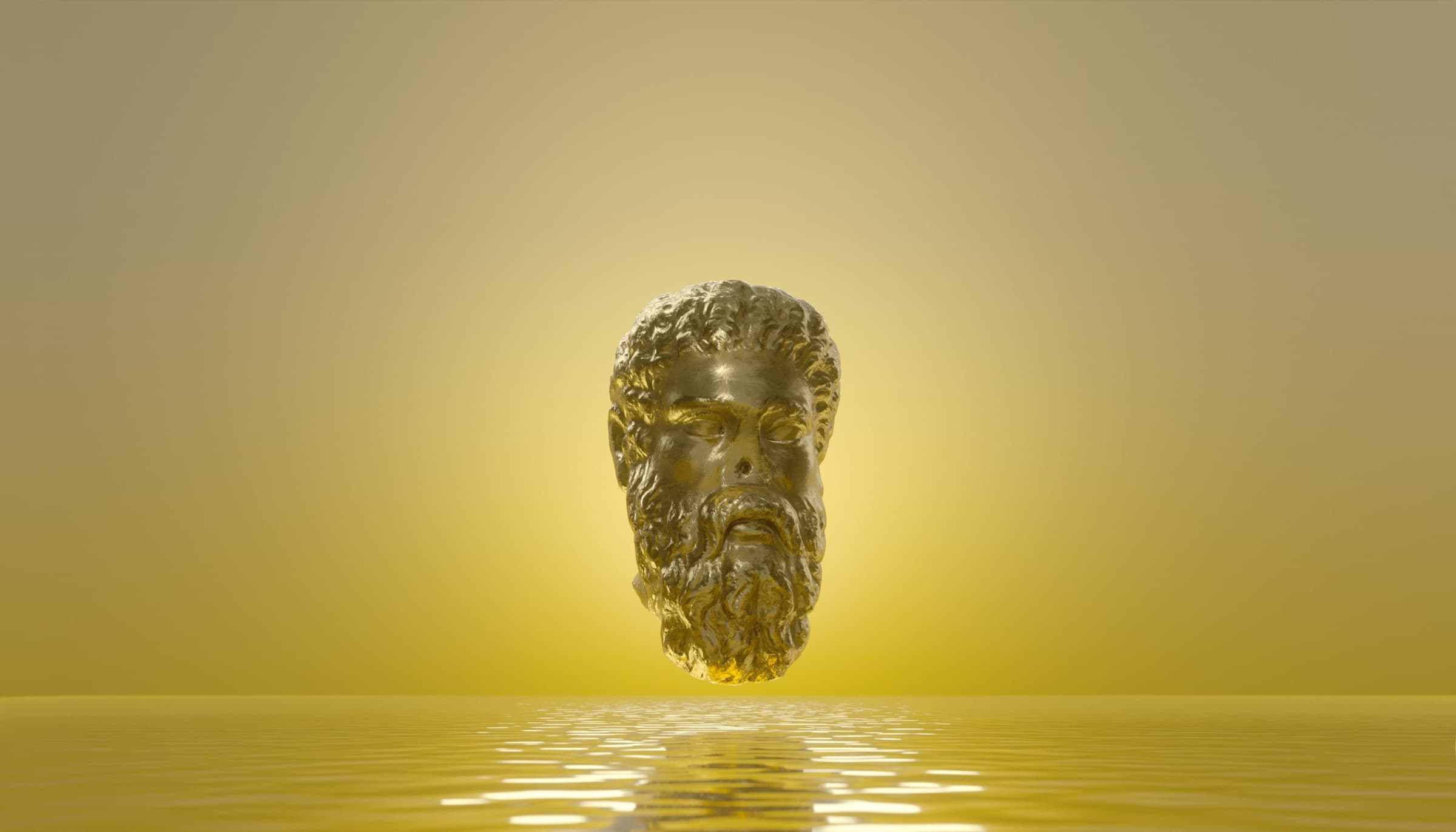
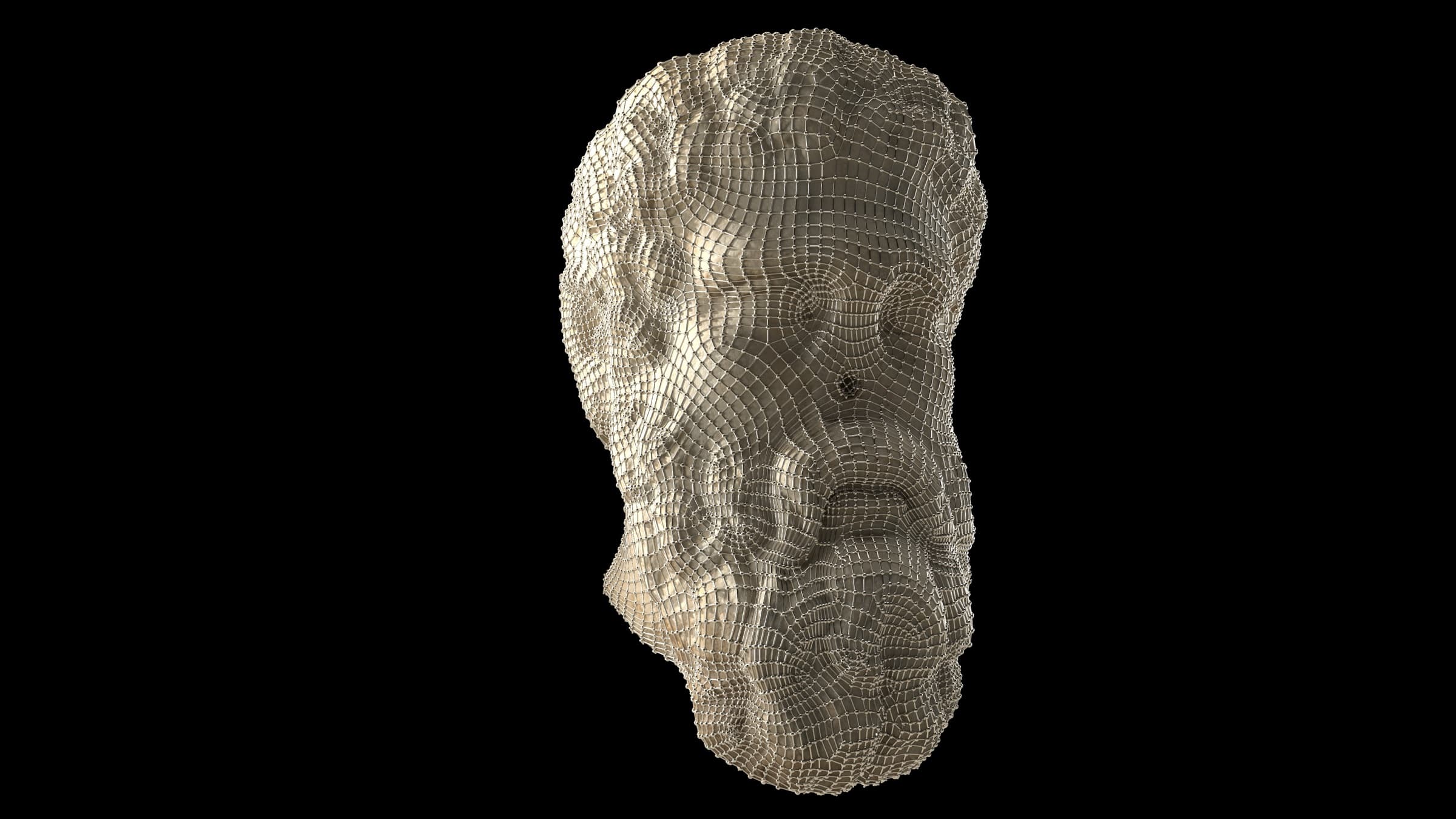
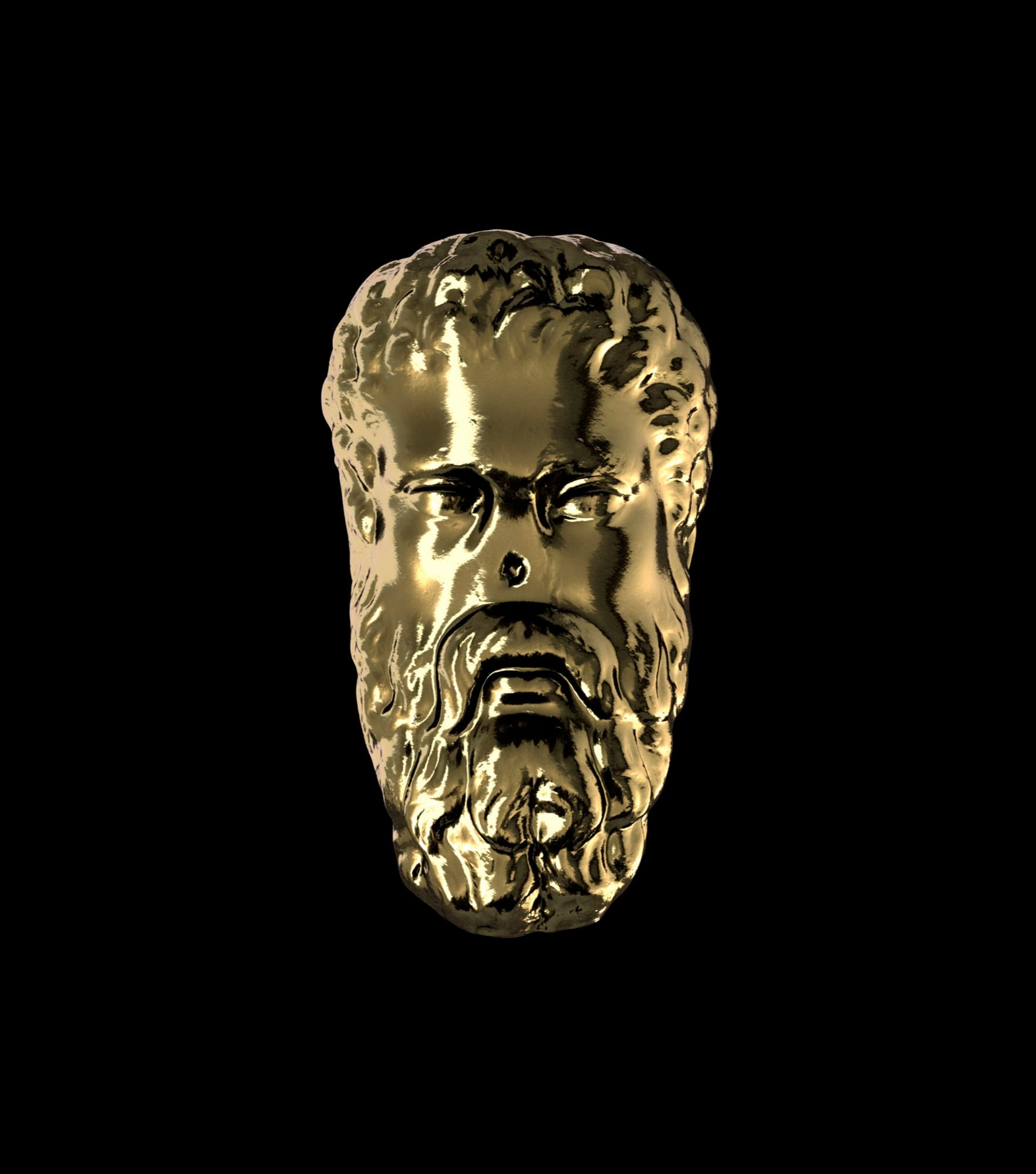
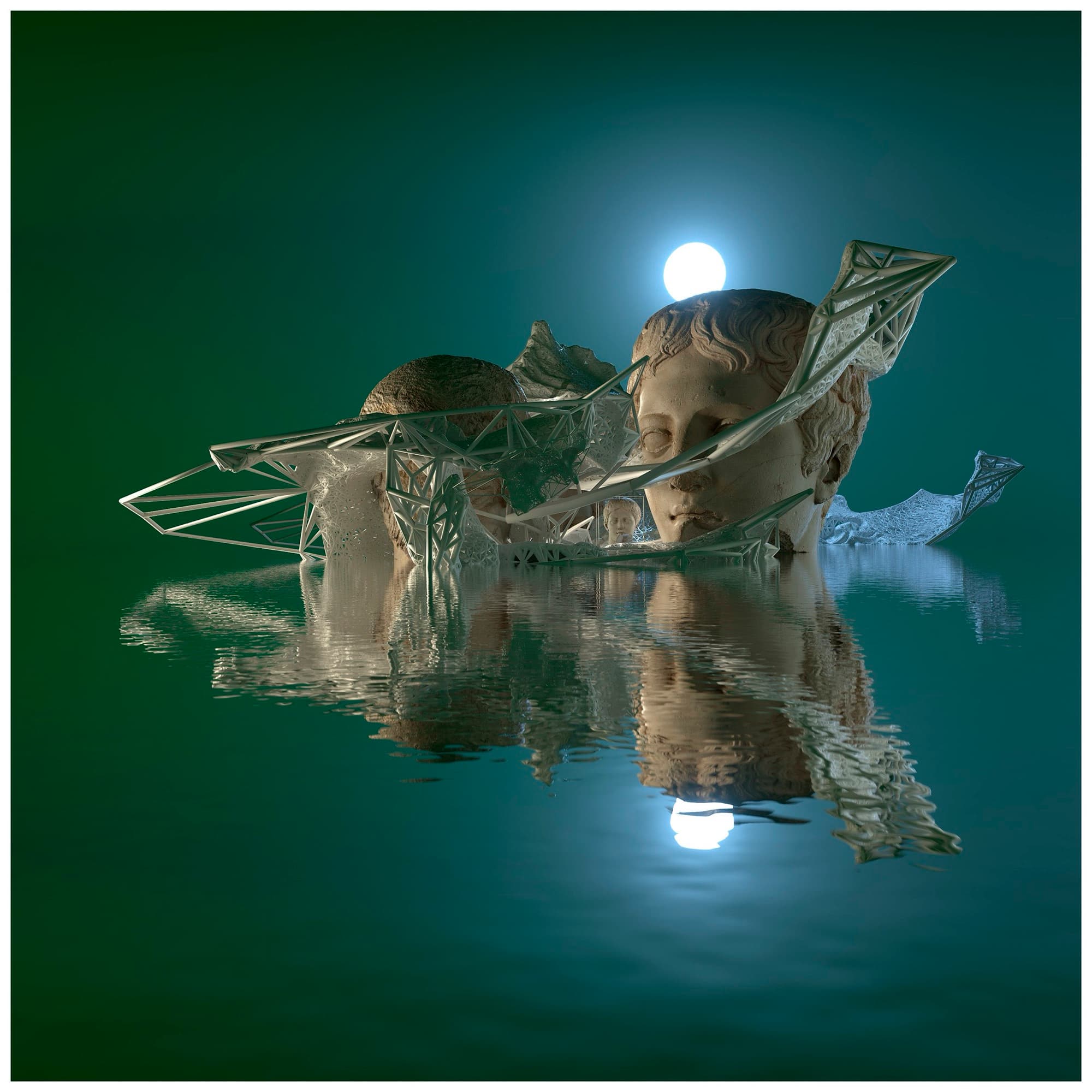
One head, rendered again and again: gold, silver, bronze, and finally a wire mesh with nothing inside it. Around them a drowned sanctuary: colossal faces half under green water, wrapped in white lattice that reads as scaffolding or as coral depending on how long you look. This is the world Dimitri Daniloff was building in 2021 and 2022, twenty years into a career spent constructing photographs rather than taking them.
Three frames from it were minted on Ethereum in April 2022 and called the Odyssey Genesis Collection. They were meant to be the cornerstones of a marketplace Olympus DAO was building. The marketplace shipped, ran, and closed. The work stayed on-chain.
The three works
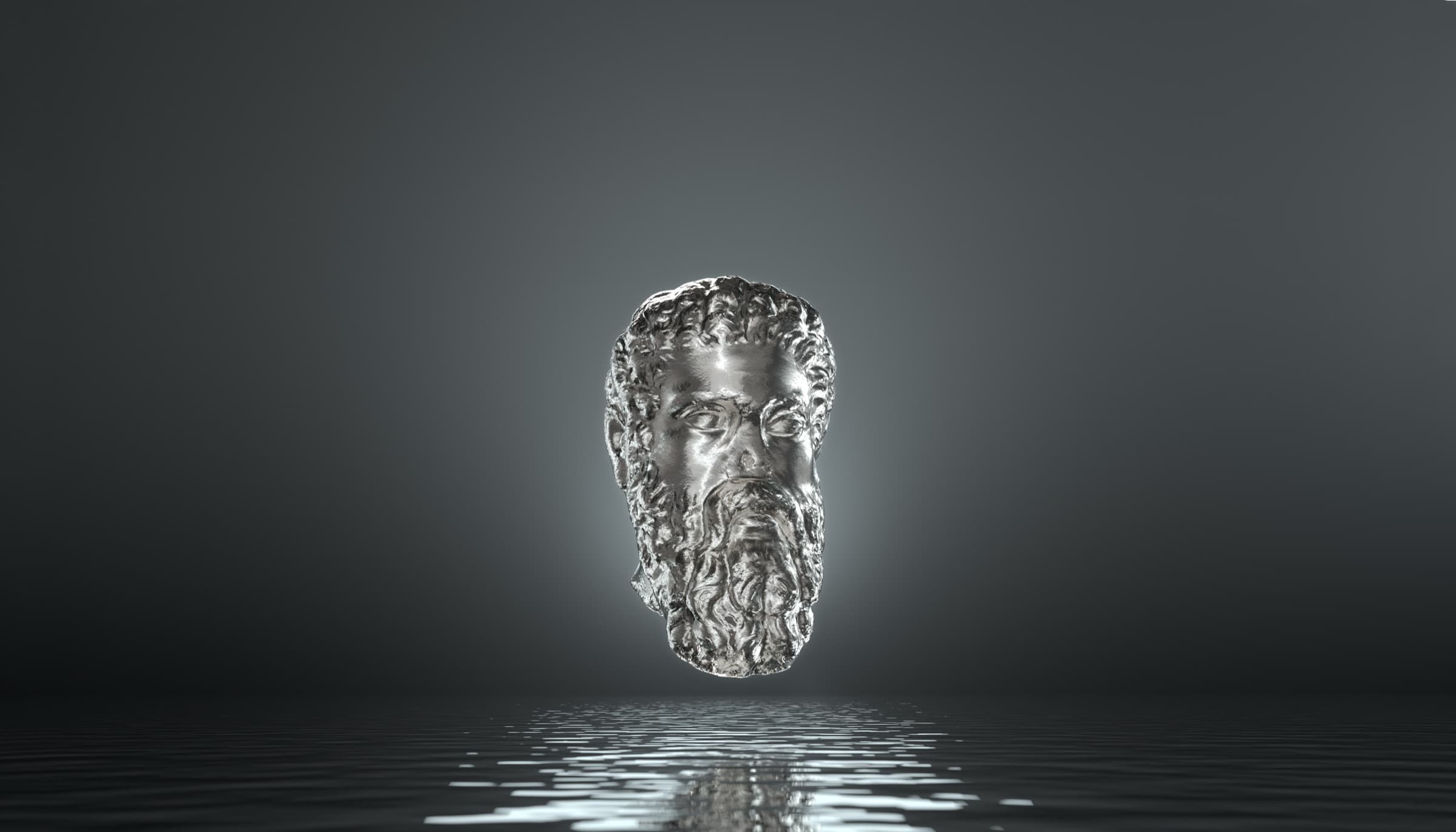
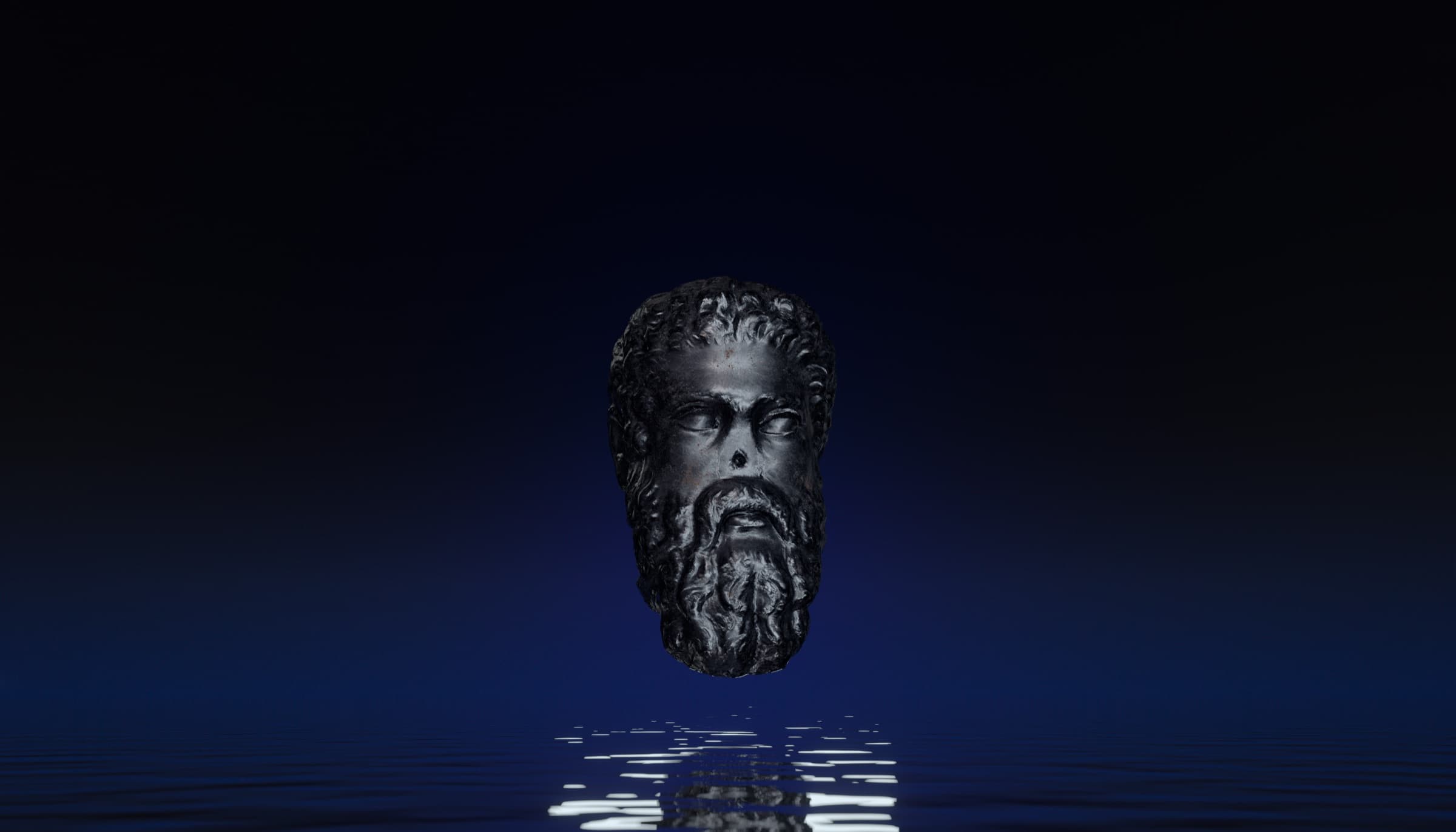
Each token is a thirty-second animation, published at 1920×1080. The stills below are frames from those animations rather than the marketplace thumbnails, which are 500 pixels wide and show you almost nothing.
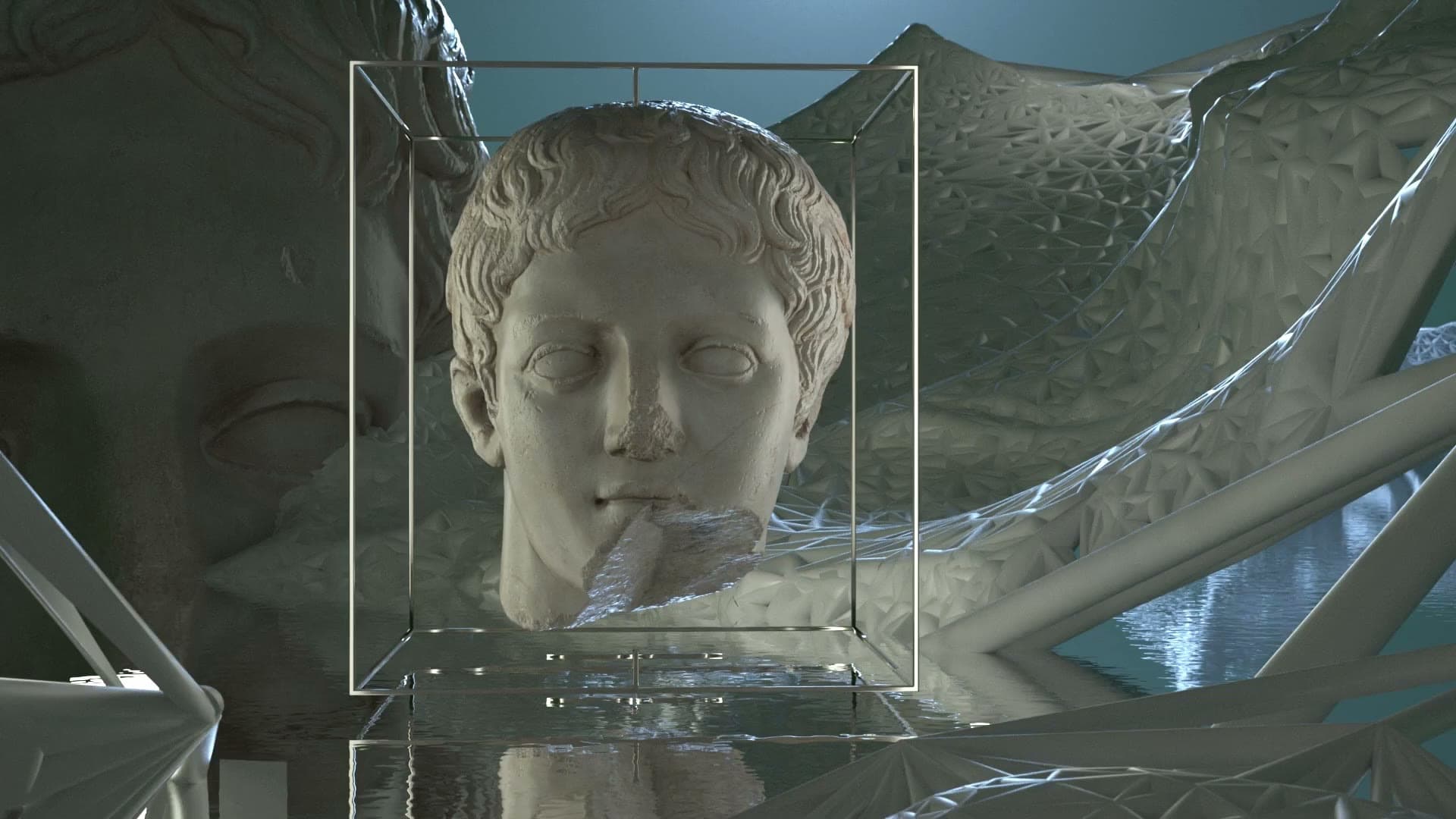
811 copies · 362 holders
The storm token. A bust held in a wire cage under a cold sky, the scene built from the same eroded stone and lace scaffolding Daniloff uses across the series. The common one, and the one most people hold.
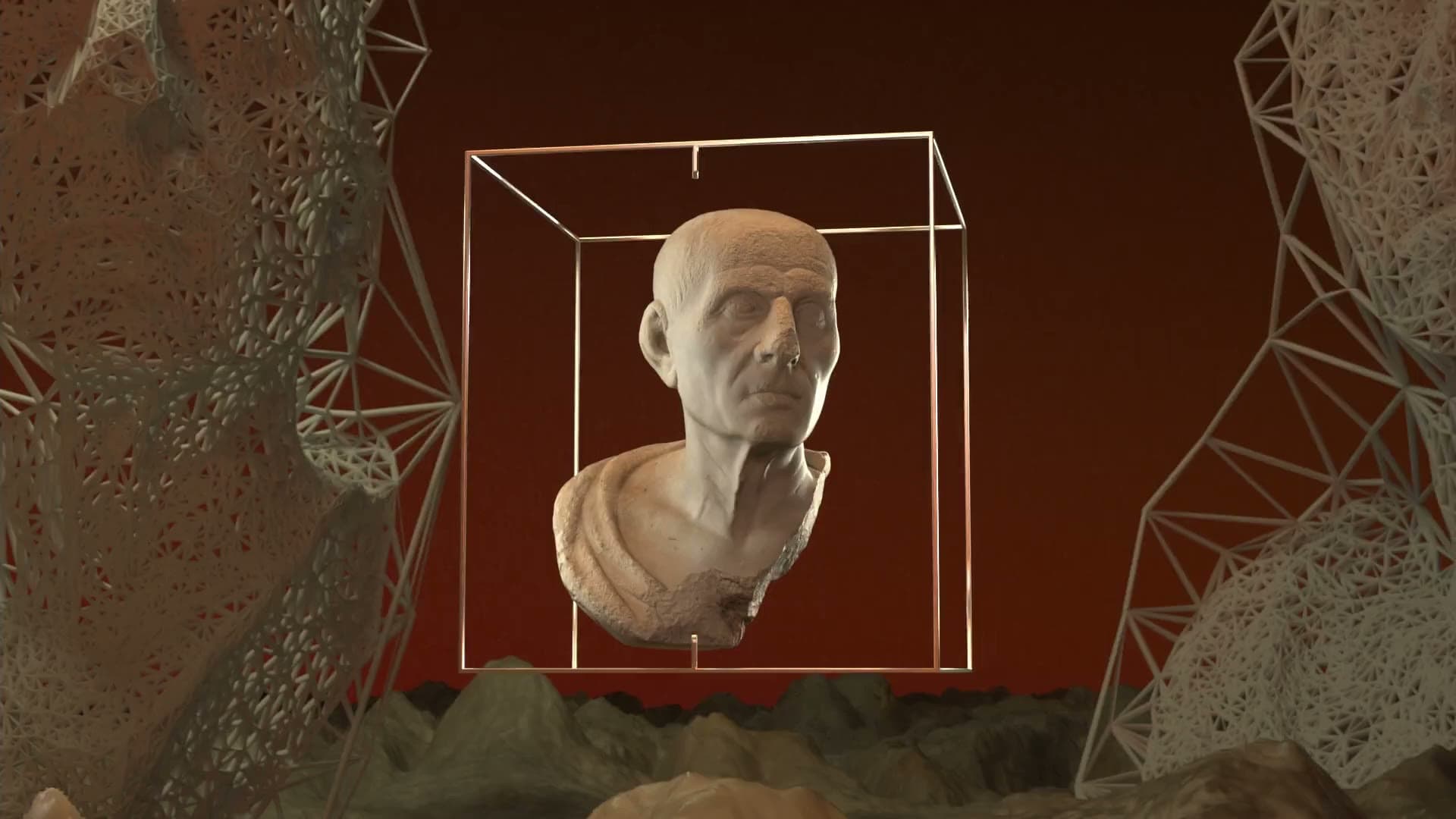
158 copies · 124 holders
Same cage, red sun, ground the colour of oxide. The one about order, which in 2022 meant treasury policy and in 2026 means whatever you want it to mean.
33 copies · 31 holders
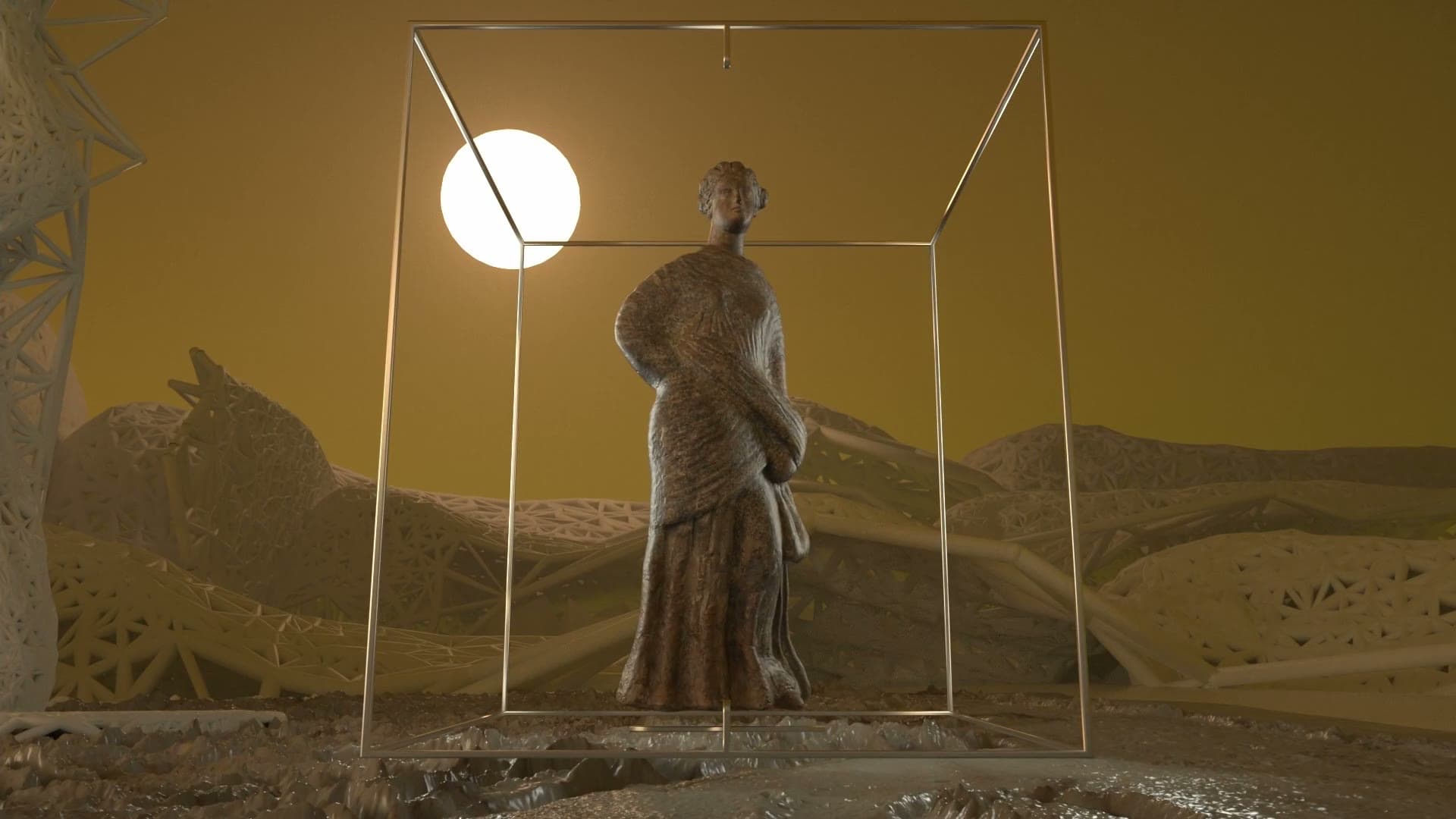
A robed figure under a white moon. Thirty-three copies against Apollo’s eight hundred, and thirty-one of them sit in separate wallets: the scarcest work here, and the one nobody trades.
Where the pointer goes
Ask the contract what token #0 is and it answers with a URL. That is how ERC-1155 works: the chain holds the balances, and a server somewhere else holds the name, the description, the image and the traits. Here is what it returns, today, unchanged since 2022:
metadata.olympusodyssey.xyz/api/metadata/1/0x527b252ed6345faa73d9bdc65a9bc409c7e3e6b7/0
That hostname has no DNS record. Not a 404, not a 500. Nothing answers, because nothing is there to answer. The domain lapsed when the marketplace wound down, and with it went the only address the contract knows.
So the tokens are intact and unreadable at the same time. Your wallet still holds them. Any indexer that cached the metadata in 2022 (OpenSea did), will keep showing you a name and a picture, and that cache is now the artwork’s only remaining copy in public hands. The Internet Archive never crawled the metadata API, only the marketing site, so there is no second copy to fall back on.
Three things follow from reading the contract itself, and each one is worse than the last.
The domain is unregistered, not merely expired
As of the date on this page, olympusodyssey.xyz has no owner. RDAP returns 404, the registry returns DOMAIN NOT FOUND, and there are no nameservers. It is not parked and it is not being held by anyone. It is available to buy, for the price of any other .xyz.
The contract cannot be pointed anywhere else
The verified ABI has twenty-two functions. The base URI is written once, inside initialize(), and there is no setter for it: no setURI, no setBaseURI, no setTokenURI. setContractURI exists but only governs the collection blurb. setRoyaltyInfo exists. transferOwnership exists. Nothing changes where uri() looks. This is not a proxy either, so there is no implementation to upgrade. The owner still holds the key, can still mint, and still cannot fix this.
So whoever buys the domain becomes the author
The contract will keep asking that hostname for as long as Ethereum runs. Anyone who registers it controls the name, description, image and traits of every token on this contract, and because the pointer is immutable, no one can route around them. Not the artist, not the contract owner, not the holders.
Put together: the artwork’s only public copy is a cache held by one company, the contract cannot be told to look anywhere else, and the address it does look at is sitting unclaimed in a registrar’s inventory. Whoever registers that domain becomes the author of record for all 1,002 tokens, permanently, and nobody could undo it.
This is not a criticism of Daniloff, who made the pictures, or of the people who minted them. It was the standard way to do it in 2022, and most of what was minted that year is one lapsed domain away from the same condition. It is the reason we are particular about whose contract a work goes on.
The supply is a pyramid
Minting ran from 29 April to 4 May 2022, with one straggler in June. Three tokens went out in wildly different quantities, and the ratio has never changed since: nothing has been burned, and the contract has no mint function anyone has used in four years.
Apollo is eighty per cent of everything on the contract. Goddess is thirty-three copies, and thirty-one of them sit in separate wallets: almost nobody who has one has two. The scarcest work on the contract is also the one that never trades, which is what usually happens when the people holding something have no intention of finding out what it is worth.
Fifty-seven sales in four years, 14.65 ETH total, the last one in December 2024. Nothing is listed. There is no floor, in the sense that there is no offer to sell at any price.
What a durable version would look like
The obvious answer is to remint somewhere better, and it is the wrong one, at least in the form people usually mean it. A fresh mint on a new contract does not repair anything. It leaves 1,002 tokens in 399 wallets exactly as broken as they were, and it puts a second, healthier version of the same three pictures into the market alongside them. That is not a rescue. That is a competing edition with better paperwork.
The version that works is a burn-and-claim, on a contract the artist owns. Transient Labs’ redemption tooling accepts any ERC-1155 on the chain as the thing being burned, not only tokens on their own contracts, which means this broken contract qualifies. A holder gives up the 2022 token and receives the 2026 one. The old supply retires as the new supply is created, so 811, 158 and 33 stay 811, 158 and 33, and there is never a point where both exist to be sold against each other.
Two things then become possible that were not possible in 2022. Metadata that is content-addressed rather than server-addressed, so the pointer is a hash and cannot be repointed by anyone, including us. And Story Inscriptions: the artist’s own account of the work, signed by their wallet and written into Ethereum’s event log. The 2022 text about the Ohmies and the storm was good writing, and it is gone, because somebody put it on a web server. That is the mistake worth not repeating.
Copy the cache before it is the only copy that mattered
Pull the three animations at full resolution out of OpenSea’s cache (1920×1080, about 160 MB together), rebuild the metadata JSON from the fields OpenSea still holds, and pin the lot to IPFS and Arweave. Publish the CIDs and SHA-256 hashes here. That converts “OpenSea has a copy” into “anyone can check their copy against a hash”, and it needs no one’s permission. It does not repair a single token, and it is still the most urgent thing on this list.
Register the domain, defensively, and say so out loud
It is the only move that restores the original tokens in place, because the contract will keep asking that hostname forever. Serve the recovered metadata, redirect the media to IPFS, and state publicly that nothing but the 2022 original will ever be served from it. Two honest caveats: it becomes a permanent obligation, and letting it lapse later would re-arm the same trap with our name on it; and holding it means holding editorial control over another artist’s work. It should end up with Daniloff. It should be registered before that conversation, not after.
Re-issue on a contract the artist owns, by burn-and-claim
An ERC1155TL deployed by Daniloff through Transient’s public factory. Holders burn the 2022 token and claim the 2026 one; Transient’s redemption tooling works against any ERC-1155 on the chain, not only their own, so the broken contract is a valid input. That matters: the old token is retired rather than orphaned, supply is preserved by construction, and there is never a moment when two versions compete for the same market.
Put the words on-chain, where a domain cannot take them
The 2022 descriptions (the Ohmies, the storm, the Goddess on the island) were the first thing to die, because they lived on the server. A Story Inscription is written into the transaction log by the artist’s own wallet. It cannot lapse, cannot be edited, and does not depend on Transient Labs continuing to exist. It is the part of this that should never have been a URL.
Whoever does not burn still has something
Redemption is opt-in and burning is irreversible, so some holders will decline, and they are not wrong to. They keep a token whose pointer is dead, which is exactly why step one is not optional and does not wait for steps two through four.
None of this has happened yet. Step one is ours to do and is not waiting on anyone; the rest is Daniloff’s call, because they are his pictures. This page is where it gets proposed in public rather than in a direct message, and where it will say so when any of it is true.
We would not be selling any of it. The contract would be his, deployed through a public factory, and we take no cut of anything, the same terms we offer every artist. What we would get out of it is the thing we actually want, which is for the work to still be legible in twenty years.
What is on the record
Everything below was read from Ethereum mainnet or the OpenSea API on 29 July 2026 and written into this page by hand. It does not update itself. When it goes stale, it gets edited, and the date above moves with it.
- Collection
- Odyssey Genesis Collection
- Artist
- Dimitri Daniloff
- Contract
- 0x527b252ed6345faa73d9bdc65a9bc409c7e3e6b7
- Standard
- ERC-1155
- Chain
- Ethereum mainnet
- Tokens
- 3: Apollo, Emperor, Goddess
- Minted
- 29 April to 4 May 2022
- Copies
- 1,002
- Holders
- 399 addresses
- Burned
- None
- Metadata
- Off-chain, at a domain that no longer resolves
- Metadata setter
- None; the base URI is immutable
- That domain
- Unregistered and available
- Lifetime volume
- 14.65 ETH across 57 sales
- Last sale
- 13 December 2024
- Listed today
- Nothing
One thing we cannot resolve. The description cached on this collection describes four Genesis NFTs. Three exist on this contract, and we have not found a fourth anywhere else. The text may predate a change of plan, or the fourth may sit on a contract we have not located. Either way, the document that would settle it was on the server that no longer answers.
Why it is up here
Not because it is rare, and not because it is cheap. Because it is a clean example of the thing this gallery keeps arguing about, and because the work is good enough to be worth the argument.
Daniloff has been constructing images for twenty years: the Daft Punk portraits, the fashion work, the twelve pieces going up on aluminium among the vines in Art & Château Nº 1. These renders are the same instinct pointed at marble instead of people: a face, lit hard, built rather than found. That they were minted into a marketplace’s launch campaign is an accident of 2022. The pictures do not need the campaign.
We do not own any of this and nothing on this page is for sale. The token pages below are the gallery’s ordinary furniture; they read from OpenSea, like every other collection here, and they will keep showing you the 2022 cache for exactly as long as OpenSea keeps it.