A series on XCOPY’s CC0 · fully on-chain · unminted

SAVE AS

A picture that dies of being sold. Copying it is free and does not touch it. Every sale runs one more pass of generation loss over the thing that moved, and at the sixteenth it is a flat field forever.

8 source works · 256 roots · 64 × 64 · 16 colours · dead at generation 16

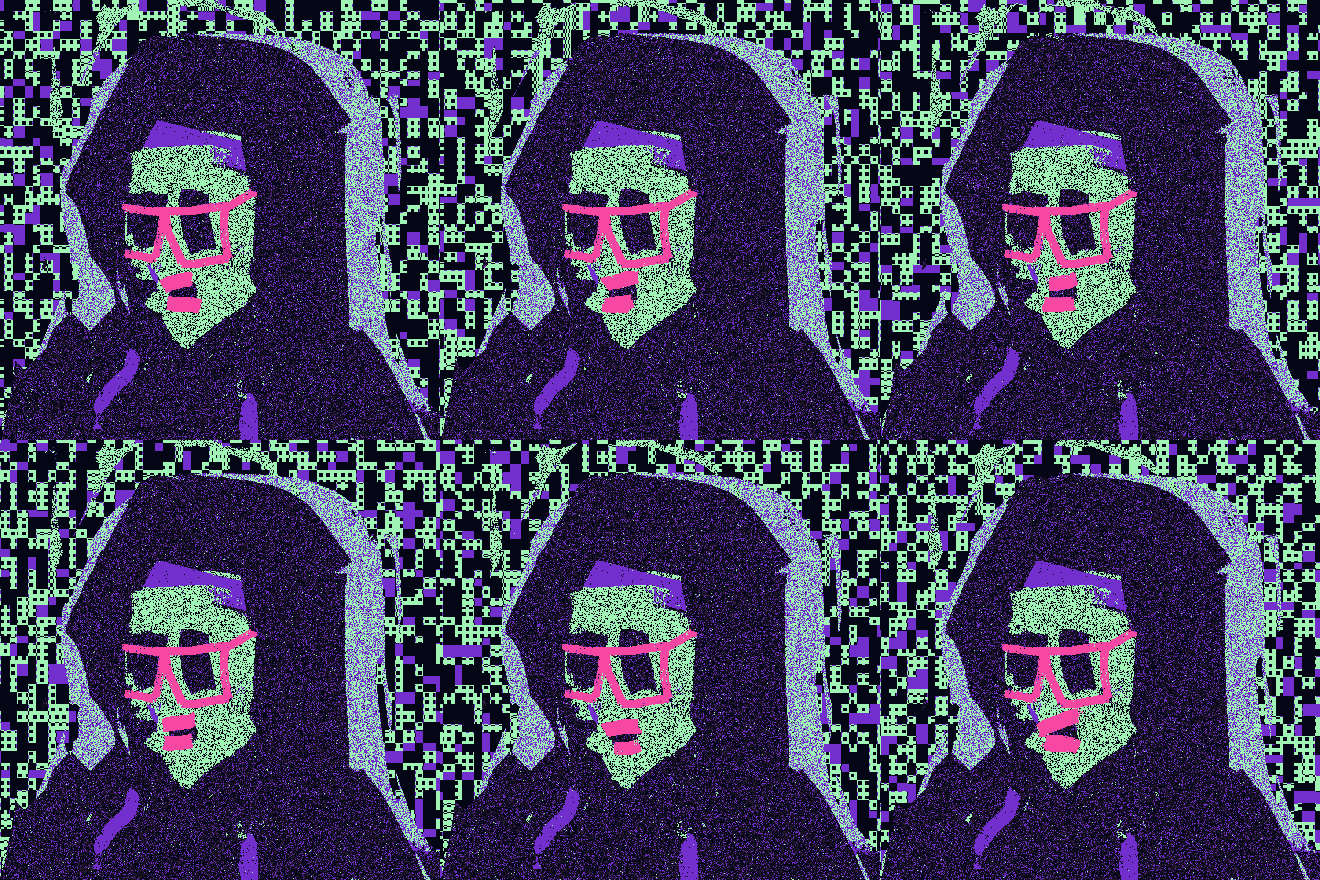
A hooded figure with a green face and hot pink glasses against a dark purple ground, flickering between four frames of glitch
Right-click and Save As guy · generation 111,305 bytes, from the chain

The licence is the material

On 1 August 2022 XCOPY put every solo work he had made, and every solo work he would make, into the public domain under CC0. His site says it in four words: no rights reserved. Seven months earlier he had done it to one work on its own. Right-click and Save As guy is a portrait of the person who saves your JPEG instead of buying it. The licence made that person legally correct.

What followed was a flood of derivatives, nearly all of them the same move: take the skull, take the flicker, change the face. That copies the surface and misses the licence. A skull on a red field does not need CC0. You can draw a different skull.

A work that actually needs the CC0 is one that reproduces his pixels. This does, and it could not legally be made about any other artist.

Two verbs, doing opposite things

Save. Anyone, any time, for gas. You get a copy of any token as it stands right now, and the one you copied is not touched. You do not have to own it. There is no limit.

Sell. Every transfer damages the token being moved, permanently, and folds the move into the seed that decides how it looks.

So copying costs nothing and harms nothing, and trading is what kills. That is the inverse of the story this market tells about itself, in which the right-click-saver is the thief and the trade is the sign of health. Here the saver is harmless and the flipper is the vandal, and the contract enforces it rather than a manifesto asserting it.

The 256 roots are given away by hand, and the consequence was not designed: a gift is a transfer, so handing someone a root ages it. Generation 1 cannot be given to anybody. It exists only in the artist’s hands and stops existing the moment it is shared.

The eight

Eight of XCOPY’s own works, re-encoded to 64 × 64 and sixteen colours and stored on chain. They are animations. His originals run from 8 frames to 32, and four of each survive here. All eight are shown at generation 1: pristine, before anything has happened to them, which is the state nobody can be given.

A hooded figure with a green face and hot pink glasses against a dark purple ground, flickering between four frames of glitch
Right-click and Save As guy
A man in a suit, mouth open, rendered in harsh black and white against bands of rainbow glitch
A Coin for the Ferryman
The word EARTH in heavy distressed red letters on black, letterboxed
Echoes of a Dead Earth
Three figures crowded into frame in pink and grey, one raising a hand, one hooded
Last Selfie
A teal and pink face with heart-shaped eyes, dissolving into a field of teal noise
Chatbot and Chill?
Two white forms dripping bright green against grey and black
Greedy Guts
A figure in white and grey against hard magenta, mostly in shadow
The Good Men Who Do Nothing
A deep red scene: a boat, two standing figures, buildings behind, letterboxed
All Time High in the City

Not by XCOPY. Not authorised by him, not endorsed by him. CC0 gives permission to copy the work; it gives no permission to imply he made this one.

Sixteen sales

One token, sold fifteen times. Every sale runs one pass of blur and rot over it. The palette halves every fourth generation: sixteen colours, then eight, then four, then two. The frames halve every single one, so the flicker is gone by the third while the picture still has thirteen to live. The timing is the first thing a copy loses.

Right-click and Save As guy at generation 1 of 16: 16 colours, 4 frames
Generation 116c · 4f
Right-click and Save As guy at generation 3 of 16: 16 colours, 1 frame
Generation 316c · 1f
Right-click and Save As guy at generation 5 of 16: 8 colours, 1 frame
Generation 58c · 1f
Right-click and Save As guy at generation 9 of 16: 4 colours, 1 frame
Generation 94c · 1f
Right-click and Save As guy at generation 13 of 16: 2 colours, 1 frame
Generation 132c · 1f
Right-click and Save As guy at generation 16 of 16: 1 colours, 1 frame
Generation 16Dead

All sixteen, in order

Generation 1 of 16

1

Generation 2 of 16

2

Generation 3 of 16

3

Generation 4 of 16

4

Generation 5 of 16

5

Generation 6 of 16

6

Generation 7 of 16

7

Generation 8 of 16

8

Generation 9 of 16

9

Generation 10 of 16

10

Generation 11 of 16

11

Generation 12 of 16

12

Generation 13 of 16

13

Generation 14 of 16

14

Generation 15 of 16

15

Generation 16 of 16

16

No two the same

Four copies of one source, each of which reached generation 9 by a different sequence of hands. Same lineage, unmistakably one work, and no two of them the same picture. Nobody composed that. It is a readout of who sold what, when.

One of four copies at generation 9, each damaged differently by the route it took

How it is made

The pictures live on chain, not in a file somewhere. Asking a token what it looks like runs the decay from the source, one pass per generation, and writes a GIF inside the call, palette and frames and timing included. Every image on this page came out of that renderer. None of it was drawn, exported or retouched.

The iteration is the point. Alvin Lucier’s I Am Sitting in a Room (1969) is a man re-recording a recording until the words are gone and the resonance of the room is all that is left. A filter that adds noise in proportion to a number produces noise; Lucier produced a room.

The consent is the point too. Rauschenberg asked de Kooning for a drawing in order to rub it out, and de Kooning, knowing exactly that, chose a hard one in ink and crayon. CC0 is that consent, given in advance, to everybody, in writing.

No admin. No renderer setter, no pause, no migration, no way to un-decay a token or mint a replacement root. The only privileged act is the constructor, and you can check that by reading the deployed code rather than this page.

Where it stands

Built and tested. The contract exists, the tests pass, and it has been put on a local chain and driven to the bottom of its ladder. It has never met a public one. Nothing here is for sale and there is no mint, and the reason is not the code: every source has to be confirmed as one of XCOPY’s solo works, and the moral-rights question deserves an opinion, before anything becomes permanent. That has been the position since 2026-08-02.

The write-up lives with the source rather than on this page, and the source is not public, so there is no link here pretending otherwise. What is worth saying out loud is that two versions of this were wrong in ways nothing caught: one quietly deleted the hot pink glasses from the most famous work in the set, because it chose the palette by how much of each colour there was and the glasses are a tiny fraction of the canvas. The other could not be deployed at all, because the sources rode in the constructor and eight of them exceed the limit on how large a transaction’s init code may be. Both passed every test.