生涯 · Genesis, 2026
Generative painting, seeded by the hash of Ethereum block 25,644,500
Direct print on brushed aluminium, 190 × 142.5 cm
Unique · Saltflat · Wide · Signal · Monochrome
The picture
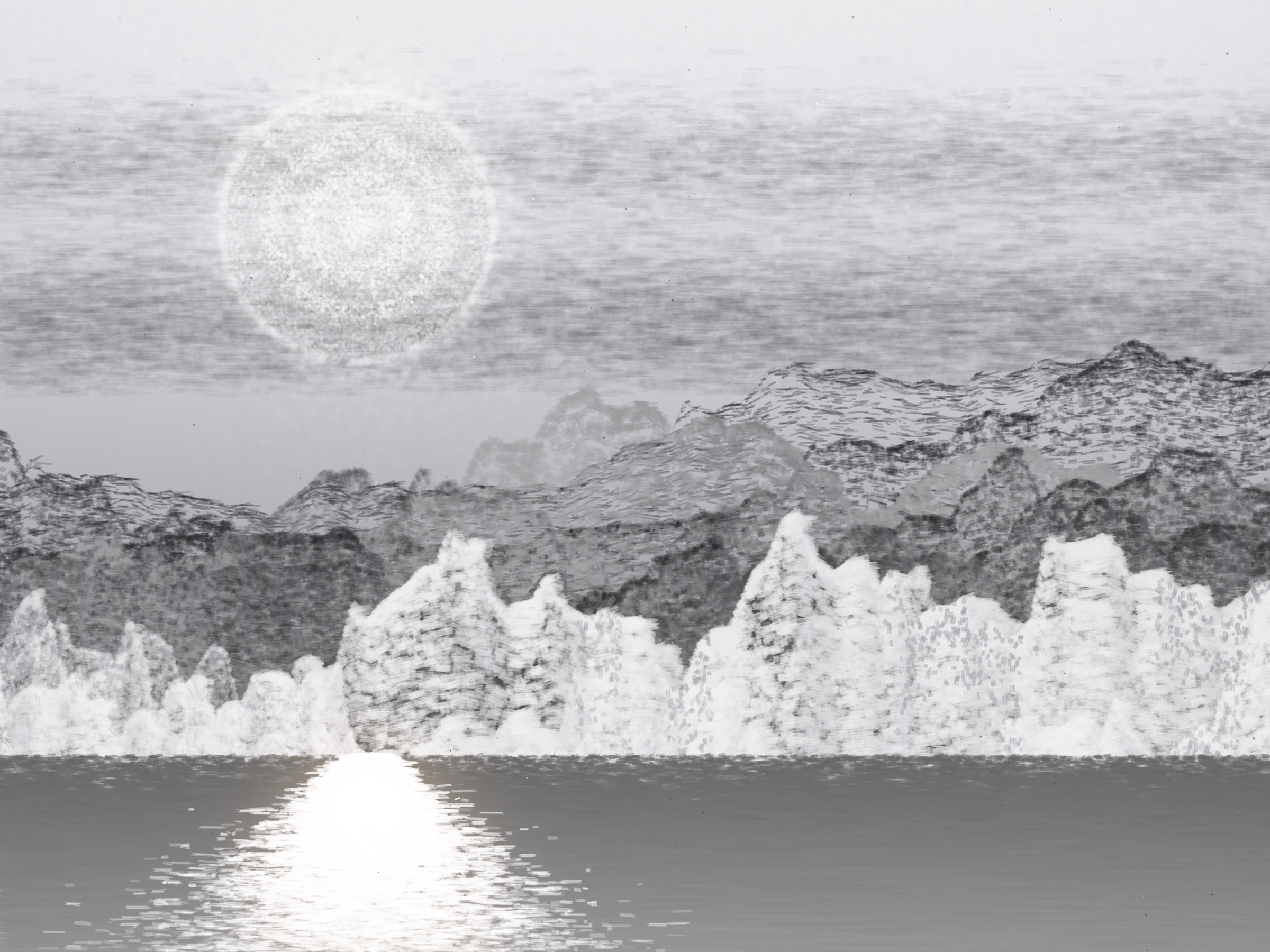
The sun is the weakest light in the work. It hangs high and left of centre, a ring of light around a grainy middle, sitting so near the value of the sky that the eye keeps losing it and going back for it. Nothing here is black and nothing here is coloured; the whole picture is pitched inside a few steps of grey. And the brightest thing in it is not the sun. It is a column of white standing on the water at the bottom of the frame, brighter than the source that made it.
The land is inverted too. Painting has spent centuries agreeing that distance goes pale — the far hill a whisper, the near rock dark and particular. Here the deepest greys sit farthest back, and the ridge nearest you is bleached to white. Not emptied: the strata run on underneath, faint under the glare, just past reading. And these ranges are years, one for each year Ethereum has been alive, standing in order with the oldest at the horizon. So the picture is arranged the way memory is. The far years are dark and particular and fully drawn. The near one is a white blur you can get nothing out of. Anyone who has lived through a market knows the feeling before they can name it: you can narrate 2018 without hesitating, and you cannot say what this week was.
Then look at where the picture puts its one loud event. The near ridge breaks once, just left of centre, and drops to the waterline; out of the gap the column comes down the sea toward you, widening as it comes, solid at the core and fraying to flecks at the edge. It does not light the water so much as cut through it. And it sets the event neither on the horizon nor in the sky where the light is supposed to live, but at your feet — in the only part of the composition you could wade into.
At 190 centimetres across, wider than a person is tall, the work is almost motionless from the far side of a room. Walk up and the stillness comes apart. What read as rock resolves into thousands of short horizontal ticks; the bleached ridge turns out to have kept every line it ever had; the column's clean edge is a scatter. Both readings are true, and the near one is not the answer to the far one — step back and the ticks disappear again.
It is printed straight onto brushed aluminium, where white is never laid down. White is only the metal left alone. So the bleached ridge and the column — the present, and the light standing on it — are not printed at all. They are the places the process declined to touch, and they are the only passages that move: walk past and they swing with you, taking the room's light and giving it back at an angle, while the greys hold still. The brightest thing in the picture is an absence, lit by the wall.
There is no contour line anywhere in it. Form accumulates out of short horizontal marks and depth is carried by value alone, the way ink landscape has always carried it. The picture looks considerably older than the process that made it.
One limit, which a work of this kind is bound to raise. The restraint belongs to the engine, not to a judgement made in front of this image; nothing was altered after the block was read. That is what the method buys — nobody, us included, chose this picture out of a set. What it costs is a work that could break its own grammar, and this engine cannot make one. The collection's discipline is that it does not pretend otherwise.
What the ranges are
A ridgeline and a price chart are the same object: height over time. Every mountain range here is one year of Ethereum's life, birthday to birthday, its silhouette drawn from that year's real daily closes and then roughened until it reads as rock instead of as a chart. The manias are the peaks. The winters are the low ground. Nothing in the terrain is invented.
Twelve ranges stand in this picture. The twelfth was hours old when it was painted, 0.07% into its year, its raw edge the present day. In the living collection a new range rises every July 30 until 2045. This piece does not grow: it is the origin artifact, static by design, the work as it stood on the morning it began.
- Work
- 生涯 · Genesis
- Artist
- Ikigai
- Painted
- 30 July 2026, Ethereum’s eleventh birthday
- Standard
- ERC-721, Transient Labs
- Chain
- Ethereum mainnet
- Contract
- 0x395c75ab8eC20dFFBd12aF0d10B77F532c2316dC
- Token
- #1
- Seed block
- 25,644,500
- Block written
- 30 July 2026, 08:33:11 UTC
- Seed
- 0xd380c04a8c8ba3aa9a3a35766f9a6ee1ee5e5ca1ffb11b7a64ee2e3aaa9cf4b1
- Ranges standing
- 12, the twelfth 0.07% into its year
- Token image
- 4096 × 3072, lossless PNG
- Print master
- 14,961 × 11,221 at 200 dpi
- 190 × 142.5 cm, direct to brushed aluminium
- Edition
- One. There is no second.
The contract, the token and the seed can each be read straight off mainnet; none of it takes our word for anything. Read it on Etherscan ↗
How to check us
The seed is the whole picture: sixty-six characters, and there is no other input. So the work is re-derivable by anyone, and that is the point of doing it this way rather than a claim about our character.
- Read the block. Ask any Ethereum node for block 25,644,500 and take its hash. That is the seed, verbatim.
- Get the engine. Check out commit
421a92c580572647aee8bb2ae9a7dad459a440ec. That is the version below, whose archive checksum is published so you know you have the painter that painted this, not a later one. - Paint it. Twelve ranges standing, the last 3% drawn. The file you get should have the sha256 published below, byte for byte.
- Compare it to the token. Fetch the pinned image from the tokenURI on any IPFS gateway and hash that too. All three agree: 13,263,615 bytes and one digest across what the engine wrote, what the receipt recorded before anything moved, and what the token now carries.
- Engine
- lattice v9
- Commit
- 421a92c580572647aee8bb2ae9a7dad459a440ec
- Archive sha256
- 9fac563a92a4363d1de7cd9e4d1511a8449933f051d0d15b1e10a5cea33bcc52
- Image sha256
- be567bd3a1075eccf4782be6f41757b75e8a194fefc4dd57501397d994f98075
- Pinned image
- ipfs://bafybeicfh4ajisz3rvkc4pk3xmu2zhbw7euabl4adwnkn4pyu3fe5rflia/media
The draw
The line on the label — Saltflat · Wide · Signal · Monochrome — is not a specification. It is nearer to a score. Twelve terms settle a piece before anything is painted: the light it stands in, the geometry of the disc, the state of the water, the geology, the palette. Every other piece in the collection is the same grammar answered differently, which is why the strings are worth reading and not just filing.
Every one of the twelve is a genuine weighted draw, and every one is proven to move pixels by a test that holds a seed, varies a single dimension and fails if the image does not change. The percentages are the real distribution across the collection.
Two of them are worth reading together. The palette is Signal, which is ink, bone and the house yellow. The chroma is Monochrome, which is ink on paper and nothing else. Between them the yellow is gone. On the day the gallery minted its first piece under its own name, the engine drew the house palette and then took the house colour out of it.
- Register
- Saltflat
- 18.0%
- Format
- Wide
- 28.0%
- Horizon
- Mid
- 29.6%
- Light
- Ringed
- 18.2%
- Water
- Glittered
- 35.7%
- Value
- Advancing
- 42.0%
- Terrain
- Strata
- 33.4%
- Relief
- Calm
- 33.9%
- Scale
- Mid
- 36.2%
- Erosion
- None
- 21.1%
- Palette
- Signal
- 8.8%
- Chroma
- Monochrome
- 23.0%
Single-trait figures only. Multiplying twelve dimensions together puts this piece at one in fourteen million, and would put very nearly any piece there, which makes it a number that sounds like rarity while measuring nothing.
The record
00:00 UTC
The twelfth range rose
Ethereum turned eleven. In every landscape of 生涯 a new range is born at the shore on that date, and every year already lived steps one deeper into the haze. The year table the engine paints from was rebuilt through the birthday’s own candle. Eleven ranges would have been a genesis one range short, delivered without an error, which is the failure the engine’s staleness gate exists to make impossible.
Morning
Block 25,644,500 was named, in public
One page of Ethereum’s near future, named while it was still unwritten. Generative art has a quiet problem: whoever holds the button can press it until they like what comes out, and everyone downstream is then buying from a set already filtered by someone else’s taste. Naming a block removes the button.
08:33:11 UTC
The chain wrote it
Sixty-four confirmations were waited out before the hash was touched, and the block was confirmed canonical: the block at the next height names it parent. Nobody could know it early, us included, and nobody could ask for a different one.
Then
The engine painted, once
From the seed and nothing else: the token image, the print master at the sheet maximum, and a receipt carrying the sha256 of every file. Twelve ranges standing, the twelfth hours old, its raw edge the present day, diving into the water where tomorrow has not happened.
The same day
The same file went to the metal
Re-rendered at print scale from the same seed, because nothing is upscaled here, ever, and ordered as a direct print on brushed aluminium at 190 × 142.5 cm. On that surface white is never printed. In this picture the whole foreground ridge and the column of light on the water are white, which means most of the light in it is bare metal, not ink. Hung in the open it does not depict the sun; it answers it.
What is not here
A machine for letting go was built for this work: every piece would have carried a standing offer, and selling into it would have stopped the writing forever: the ranges stop arriving, the light settles onto the horizon and never moves again. Clock, room, renderer: written, tested, published.
It is not deployed. That machine lives in a pool where a paid ticket draws for a prize, which is a lottery in most legal frameworks, and a verifiable random draw does not change that. It is a question for counsel rather than for code, and the reasoning is laid out with the holes left in on the desk.
So 生涯 ships on ordinary audited Transient Labs contracts and nothing more exotic, and the machinery stays public, readable and holding nobody's money. The tell that this was the right call is that nothing about the art needed it. This is the same picture either way.